In crisis? Dial 988 Then press 1 for Veterans crisis line, 24/7

Here's what the research says
Anyone offering you a brain treatment should be willing to show their work, including the parts that are inconvenient. This page is that. If you would rather have this conversation with a person, call (816) 402-0322.
FDA clears Wave Neuroscience’s MeRT System for PTSD[1]
FDA grants the MeRT System Breakthrough Device designation[1]
TMS first cleared by the FDA; now cleared across several indications[5]
Peer-reviewed publication of the pivotal PTSD trial
The FDA clearance, precisely
On 11 June 2026, the U.S. Food and Drug Administration cleared Wave Neuroscience’s MeRT System for post-traumatic stress disorder. It is the first personalized, biomarker-guided neuromodulation technology to receive clearance for PTSD.[1]
The clearance followed a double-blind, randomized, sham-controlled multisite trial conducted with the Institute of Biosciences and Technology at Texas A&M Health. The principal investigator was Dr. Ken Ramos, MD, PhD, Distinguished Professor and Executive Director of the Institute. The FDA had granted the system Breakthrough Device designation in 2024.[1]
Two things worth being precise about, because plenty of clinics are not:
“Cleared” is not “approved”
Clearance under 510(k) and the De Novo pathway means the FDA has reviewed safety and effectiveness evidence for a specific indication. It is a real regulatory bar. It is not the same process used for new drugs.
The trial isn't published yet
The peer-reviewed publication of that trial is still forthcoming at the time of this review. The FDA has seen the data. The journals have not published it yet. We will link it here the day it appears.
Broader TMS clearances
Transcranial magnetic stimulation more generally has been FDA-cleared since 2008 and now carries clearances across several indications:[5]
- Major depressive disorder (incl. ages 15+)
- Anxious depression
- Obsessive-compulsive disorder
- Smoking cessation
- Migraine pain
A correction we would rather make ourselves
You will see claims around the internet, including on some clinic websites, that TMS is FDA-cleared for insomnia. It is not. Sleep improvement is one of the most consistently reported outcomes in the MeRT literature, and it is one of the first changes our own participants describe, but it is not a cleared indication, and we are not going to describe it as one.
Reported outcomes, with sources
We only list figures we can point you to. Where a number in this field comes from a chart review rather than a controlled trial, we say so, because the difference matters.
Average reduction in PTSD symptom severity (PCL-5)
Of those above threshold no longer met clinical criteria for PTSD at program end
Reduction in post-concussion symptom scores (RPQ)
Reduction in pain interference (BPI-PI)
| Finding | Population | Study type | Source |
|---|---|---|---|
| 37.6% average reduction in PTSD symptom severity (PCL-5) | 33 male special operations forces veterans with TBI and PTSD symptoms | Retrospective chart review Not randomized, no control group | Front. Neurol. 2025[2] |
| 69% no longer met clinical criteria for PTSD at program end | Participants from the same cohort scoring above the PCL-5 threshold of 33 | Retrospective chart review | Front. Neurol. 2025[2] |
| Significant reductions in PTSD and depression symptoms | Active-duty special operations service members | Retrospective chart review | Front. Psychiatry 2024[3] |
| 54.0% reduction in post-concussion symptom scores (RPQ) | Special operations veterans with TBI and PTSD, same chart review | Retrospective chart review | Front. Neurol. 2025[2] |
| 44.4% reduction in pain severity (BPI-PS) and 60.6% reduction in pain interference (BPI-PI) | Same cohort | Retrospective chart review | Front. Neurol. 2025[2] |
| 42% no longer met criteria for PTSD; 46% no longer met severity thresholds for depression | Active-duty special operations service members | Retrospective chart review | Front. Psychiatry 2024[3] |
| Improvement in depression, sleep, post-concussive symptoms and executive function; gains retained at two-week follow-up | Post-concussion cohorts receiving rTMS | Cohort studies Summarized in federal evidence review | VA ESP, 2020[4] |
| Significant changes in symptom severity and EEG measures after two weeks of EEG-guided stimulation | 80 retired military veterans with PTSD | Case series | VA ESP, 2020[4] |
| Most common side effects: headache and fatigue; no serious adverse events reported | SOF veteran cohort, n=33 | Safety reporting Within chart review | Front. Neurol. 2025[2] |
Swipe sideways to see the full table on a phone.
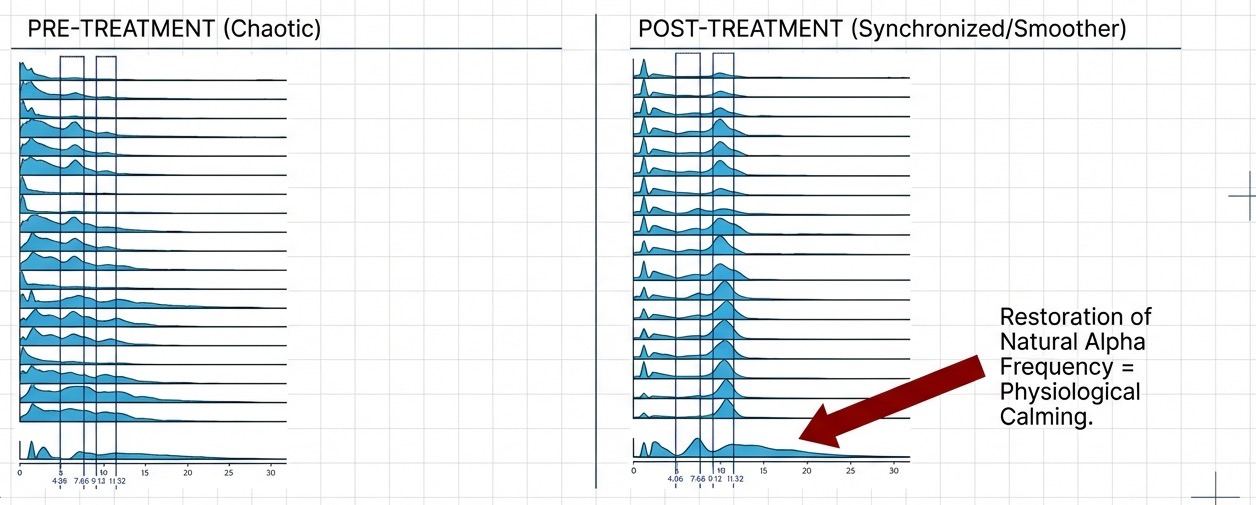
qEEG magnitude spectra, before and after a course of treatment — the alpha peak reorganizing across channels. Operation Zero clinical materials.
Where the evidence is thin
This is the section most clinics leave out. We are including it because you are a grown adult making a medical decision, and because we would rather you hear it from us.
Most published MeRT data is not randomized
Chart reviews and case series are real evidence, but they cannot separate treatment effect from expectation, from regression to the mean, or from the fact that someone finally paid attention to you for a month. The randomized sham-controlled PTSD trial behind the 2026 clearance is the strongest evidence in this field to date, and it is not published yet.
One earlier randomized trial was negative
The VA’s 2020 evidence review noted a small randomized trial (8 subjects, abstract only) that found no significant difference between MeRT and sham.[4] Eight people is far too few to conclude much in either direction, but we are not going to pretend it does not exist.
Pain and substance use are the weakest areas
The VA review explicitly found no published studies for EEG/EKG-guided resonance therapy in several of these conditions, including chronic pain, opioid dependency and alcohol dependency.[4] We treat people in these categories because the underlying dysregulation is the same target, but the specific evidence base is not there yet, and any clinic quoting you a precise remission percentage for opioid or alcohol use from MeRT should be asked for the citation.
Study populations skew toward special operations veterans
Highly selected, highly motivated, generally young and physically fit. How well those results transfer to a 58-year-old retired firefighter with sleep apnea and two knee replacements is an open question.
Durability is not well characterized
Follow-up windows in the published work are short. We do not yet know with confidence how long the gains hold, or who needs a maintenance course.
What we will and won't tell you
We will tell you
- What your qEEG shows
- Whether we think you are a good candidate
- What the realistic range of outcomes looks like
- When this is not the right tool for you
We won't tell you
- That it works for everyone, because it does not
- A statistic we cannot source
Sources
- Wave Neuroscience. “Wave Neuroscience Announces FDA Clearance of MeRT® for PTSD.” PR Newswire, 11 June 2026. Read it.
- Individually guided neuromodulation in special operator veterans with symptoms of PTSD and traumatic brain injury: preliminary data from a chart review. Frontiers in Neurology, 2025. PMC11864959.
- A retrospective chart review to assess the impact of alpha-guided transcranial magnetic stimulation on symptoms of PTSD and depression in active-duty special operations service members. Frontiers in Psychiatry, 2024. PMC11224515.
- U.S. Department of Veterans Affairs, Evidence Synthesis Program. Evidence Brief: Transcranial Magnetic Stimulation (TMS) for Chronic Pain, PTSD, TBI, Opioid Addiction, and Sexual Trauma, December 2020. NCBI Bookshelf.
- American Psychological Association. “FDA clears transcranial magnetic stimulation for youth, and a shorter version for adults.” APA Services.
The evaluation tells you more than this page can.
A qEEG is objective, free, and takes about an hour. Whatever you decide afterward, you will know something about your own brain that you did not know before.
Medical notice. This page is for general information and does not replace a clinical evaluation, diagnosis, or the advice of your own licensed provider. MeRT is delivered under clinician supervision after a qEEG evaluation, and it is not appropriate for everyone. Individual results vary. Do not stop or change a prescribed medication without talking to the prescriber.